
The Fighter
Encouragement, Tips, and Strategies for Those Facing Physical and Emotional Ordeals
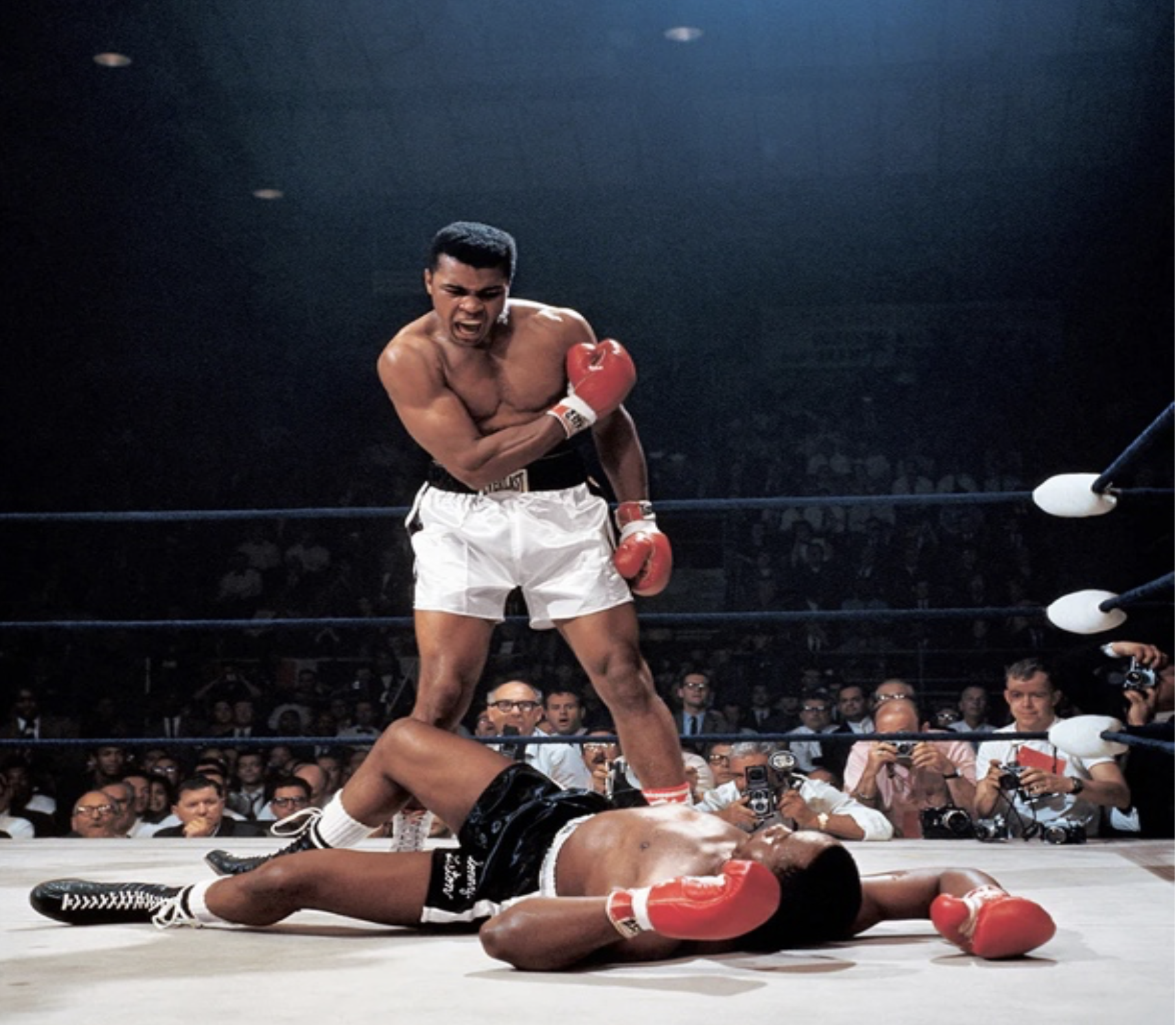
Muhammad Ali knocking out Sonny Liston in the first round of their famous world heavyweight boxing championship rematch—May 25, 1965.
The parable and essay below are messages about myself and the current physical and mental health challenges I'm facing at age 84 (for specific battle details, please see APPENDIX I on pages 13–14). They can also apply to people of any age who are wrestling with life issues such as:
Retirement & Aging's numerous challenges
Immobilizing health problems
Emotional traumas
Financial stresses
Long-standing habits & addictions
Loneliness
Is It Time for the Fighter to Quit?
How should the boxer apply the advice of Kenny Rogers' song The Gambler: "Know when to hold 'em, when to fold 'em, and when to walk away"?
Is this the end of a fighter's long boxing career? In mixed martial arts terms, are the boxer's injuries and aging forcing him to tap out of all future matches? Is he washed up, useless now? If so, how can he cope? What should he do with the rest of his life?
In my case, is it now time for me to cease my writing, counseling, and speaking and quietly fade into a "retirement" from all stresses and deadlines? The following parable describes my current quandary.
Many are facing similar decisions about their future. Hopefully this essay will provide hope and guidance not only for me as I write and think about how to apply its words, but also for others.
The Fighter
Edward's boxing career recorded 59 wins (34 by knockouts) and 7 close losses. During his "sweet science" profession, he'd been knocked down several times but never knocked out. His pugilistic occupation endured the usual side effects of bruised ribs, blackened eyes, a broken nose, wrecked fingers, a throat injury, and numerous undiagnosed concussions.
The years and punches have taken their cumulative toll. Edward has lost his edge against faster, stronger opponents. He's slowed down, gained weight, lost his punching power, and used up his former stamina for going ten to twelve rounds.
Recently, his manager put together a series of four lucrative, money-making fights. Edward reasoned that George Foreman and Mike Tyson, long after their active careers had ended, fought men almost half their age. He thought he could, too. So he signed on.
Somehow, in this latest fight, Edward eked out a decision against his first adversary. But to win, his body and brain took a hard beating for ten brutal rounds.
Following this recent but costly victory, Edward asked himself:
Should I continue?
How much longer can I handle the lengthy, arduous training schedule of running, exercising, and sparring?
How many more punches can I absorb?
Even if I win my next three fights, I might incur severe, possibly life-threatening injuries. Although I've always donated 70% of my earnings to charities, is it worth it?
Or, should I totally disengage from anything related to boxing, hang up my battered gloves and body, and simply coast through my final years?
The famous quote, "Fatigue makes cowards of us all," is attributed both to coach Vince Lombardi and General George S. Patton. Fatigue describes the negative effects of both debilitating exhaustion and burnout. Weariness makes us prone to mistakes and poor decisions. Its hallmarks are withered energy, willpower, discipline, and courage.
Preserving our resilience and fighting spirit means finding a balance between work and play. A tall order for anyone.
Key Questions for Myself (and Other Fighters for Better Physical and Mental Health)—Should I:
Seat myself at the table of self-pity: table of one?
Continue to resent the "unfairness" of my plight?
Stop trying to reinvent myself and stop setting new goals?
Simply withdraw from people, projects, and hobbies?
Kick my life into neutral gear and simply drift by numbing myself with TV binges, video games, or other time-filling pacifiers?
Distract myself from anxieties with TV binging, work, travel, hobbies, or service projects?
Content myself to quietly fade into the sunset? OR
View my "troubles and sorrows" as challenges to cope with or overcome?
Throughout the centuries, when God's people were ready to give up or fold up their tents and fade away, God sent messengers (Greek for "angels") to encourage those strugglers to "hang on," "not quit," and "Never give up."
Long ago, the Old Testament leader Moses was discouraged from "keep on keeping on" because of his age and infirmities. The constant opposition from the very people he was trying to help, and other forms of resistance, drained his energy and robbed him of his enthusiasm. He was ready to hang up his "career."
God simply said to him:
"I will be with you." (Exodus 3:12)
Just as God had encouraged Moses when he was 80 years old, exhausted (Exodus 7:7), and ready to quit, so Moses passed on similar reassuring words to his successor, Joshua:
"Be strong and courageous. Do not be afraid; do not be discouraged, for the Lord your God will be with you wherever you go." (Joshua 1:9)
Catch God's words to the aging Joshua:
"When Joshua had grown old, the Lord said to him, 'You are now VERY OLD, and there are STILL very large areas of land to be taken over.'" (Joshua 13:1)
Notice Joshua's response to God's (and other "messengers'") reassurance:
"Just as the Lord promised, he has kept me alive for forty-five years since he said this to Moses while Israel was moving about in the wilderness. So here I am today, eighty-five years old! I am still as strong today as the day Moses sent me out; I'm just as vigorous to go out to battle now as I was then. Now, give me this hill country that the Lord promised me that day. You yourself heard then that the Anakites were there and their cities were large and fortified, but the Lord helping me, I will drive them out just as he said." (Joshua 14:11)
In recent times, one such messenger (angel) was the famous New York Yankee catcher, Yogi Berra, who quipped: "It ain't over till it's over!"
This yogi-ism remark was made when his team was behind in a key game against the New York Mets, intended to hearten his teammates and rally them to keep going.
Questions to ponder:
Who are God's messengers to you right now?
Who are you being a messenger to right now?
Suggestions for Those Contending with Physical and Emotional Wounds
1) Determine Not to Quit.
The battle starts in our mind—
"For as he thinketh in his heart, so is he." (Proverbs 23:7)
Mentally fight to not absorb your own false beliefs about your ills, as well as society's beliefs about aging and physical or mental handicaps. Practice each day visualizing yourself as looking, feeling, and acting healthier. Replay mental videos of yourself, repaired and renewed.
The Bible underscores the value of using positive thinking:
"Whatever is true, whatever is noble, whatever is right, whatever is admirable—if anything is excellent or praiseworthy—think about such things." (Philippians 4:8)
Try your best to use positive, affirmative self-talk like, "In spite of how I feel, I will make it through this tough time … Others need me … God will show me the way out of my hopelessness."
Alcoholics Anonymous teaches, "Fake it 'til you make it." Pretend, imagine, and picture yourself with your despondency behind you, enjoying life again. This will be a mental battle, but it's doable. It will make a huge difference as you force yourself to practice using an upbeat mindset and approach.
Yet, positive thinking alone will not be enough. You will need other people and other tools to keep you afloat during your storms.
Recovery resources are essential to your well-being before, during, and after a major loss. Sometimes, you'll come across helpful tips and tactics in the midst of your trauma that will help you to keep going. But after your situation begins to improve, you'll usually need additional life-enhancing support to move forward with your new life.
Take courage from the first stanza of Dylan Thomas' famous poem, Do Not Go Gentle Into That Good Night:
Do not go gentle into that good night, Old age should burn and rave at the close of day; Rage, rage against the dying of the light.
Just Fight One More Round!
Be stirred to endure your troubles by the words of heavyweight boxer James Corbett.
It happened 120 years ago. On September 7, 1892, James J. Corbett won the first heavyweight championship prize-fight in which the contestants used boxing gloves rather than their bare fists. Corbett won the match against John L. Sullivan with a knockout in the twenty-first round. That's right, the 21st round! (Amazingly, three years earlier, Corbett had to go 27 rounds, boxing with bare knuckles, to defeat fellow Hall of Famer Joe Choinski).
Besides Corbett's boxing prowess, he had a way with words. When asked how he'd been so successful as a boxer, he replied, "Fight one more round!":
When your feet are so tired that you have to shuffle back to the center of the ring, fight one more round.
When your arms are so tired that you can hardly lift your hands to come on guard, fight one more round.
When your nose is bleeding, and your eyes are black, and you are so tired you wish your opponent would crack you one on the jaw and put you to sleep, fight one more round—remembering that the man who always fights "one more round" is never whipped!
Even the best Christians can encounter recurring health issues like sprained backs, skin cancers, ulcers, and UTIs. They also make poor decisions, fall into addictive habits, or crash in harmful ways—often repeating misjudgments and bad habits time and again. The Bible recognizes this reality:
Though the righteous fall seven times, they rise again. (Proverbs 24:16)
God mercifully offers the solution to human failures:
If we claim to be without sin, we deceive ourselves and the truth is not in us. If we confess our sins, he is faithful and just and will forgive us our sins and purify us from all unrighteousness. (1 John 1:8–9)
Compassionately, He extends His help to those struggling with weaknesses:
Do not fear, for I am with you; do not be dismayed, for I am your God. I will strengthen you and help you; I will uphold you with my righteous right hand. (Isaiah 41:10)
Years ago, Bert Sugar, a famous boxing historian, commented on another boxing comeback legend, Floyd Patterson:
Two-time heavyweight boxing champion Floyd Patterson was almost too nice a man to be in a sport that at times can be brutal. Sensitive to a fault, he donned a disguise to hide his shame after being knocked out by Sonny Liston in defense of his crown and cared enough to pick up fallen opponents and help them back to their corners. Once, I asked Patterson if he knew he had been knocked down more times than any other in history. He mildly answered, "Yes, but I got up more times than anyone."
Strange as it may seem, Bible statements, famous quotes, and oft-quoted poems have been large motivators for me in times of discouragement or challenge since my high school days. They've kept me on my feet many times in the midst of discouragement or huge challenges.
Here are a few:
The Man in the Arena, by Theodore Roosevelt
It is not the critic who counts, not the man who points out how the strong man stumbles or where the doer of deeds could have done them better. The credit belongs to the man who is actually in the arena, whose face is marred by dust and sweat and blood; who strives valiantly; who errs, who comes short again and again, because there is no effort without error and shortcoming; but who does actually strive to do the deeds; who knows great enthusiasms, the great devotions; who spends himself in a worthy cause; who at the best knows, in the end, the triumph of high achievement, and who at the worst, if he fails, at least fails while daring greatly, so that his place shall never be with those cold and timid souls who neither know victory nor defeat.
If You Think You Are Beaten, You Are, by Walter D. Wintle
If you think you are beaten, you are If you think you dare not, you don't, If you like to win, but you think you can't It is almost certain you won't.
If you think you'll lose, you're lost For out of the world we find, Success begins with a fellow's will It's all in the state of mind.
If you think you are outclassed, you are You've got to think high to rise, You've got to be sure of yourself before You can never win a prize.
Life's battles don't always go To the stronger or faster man, But soon or late, THE MAN WHO WINS IS THE MAN WHO THINKS HE CAN!
Game Called, by Grantland Rice
Game Called. Across the field of play The dusk has come, the hour is late. The fight is done and lost or won, The player files out through the gate. The tumult dies, the cheer is hushed, The stands are bare, the park is still. But through the night there shines the light, home beyond the silent hill.
Game Called. Where in the golden light The bugle rolled the reveille. The shadows creep where night falls deep, And the taps have called the end of play. The game is done, the score is in, The final cheer and jeer have passed. But in the night, beyond the fight, the player finds his rest at last.
Game Called. Upon the field of life The darkness gathers far and wide, The dream is done, the score is spun that stands forever in the guide. Nor victory, nor yet defeat is chalked against the player's name. But down the roll, the final scroll, shows only how he played the game.
2) Stay Connected to Others.
Poet John Donne and numerous contemporary singers, such as Joan Baez and Simon and Garfunkel, were right to sing that No Man Is an Island. When an animal or bird is wounded, it often slinks away to quietly recover. Humans aren't much different.
Yet the Bible notes:
Two are better than one, because they have a good return for their labor: If either of them falls down, one can help the other up. But pity anyone who falls and has no one to help them up. Also, if two lie down together, they will keep warm. But how can one keep warm alone? Though one may be overpowered, two can defend themselves. A cord of three strands is not quickly broken. (Ecclesiastes 4:9–12)
In your confusion, reach out for comfort, for encouragement from others via a phone call, text, email, or note.
3) Every Day, Make the Most of Every Opportunity by Doing Three Things:
Although severely disabled, blind and deaf, Helen Keller declared:
I am only one; but still, I am one. I cannot do everything, but still, I can do something; and because I cannot do everything I will not refuse to do the something that I can do.
The Bible urges us to:
Be very careful, then, how you live—not as unwise but as wise, making the most of every opportunity.
Every day, achieve something, no matter how small—like emptying the garbage can, mailing a letter, or walking your dog. Every victory counts! This will give you a sense of achievement, especially in times of uncertainty.
Daily, do something to help someone—Roman Catholic Bishop Fulton Sheen's motto was: "It's better to light one candle than to curse the darkness." Do a good deed each day or say a kind word. This will encourage another person, temporarily take your mind off your problems, and give you a sense of usefulness.
Daily pray for yourself and somebody else—The Bible says, "You do not have because you do not ask God." (James 4:2) While I wrestled with "what to do next," there were times I floundered because I didn't reach out for God's help. Yet God invites us to talk with Him:
"Call to me, and I will answer you and tell you great and unsearchable things you do not know." (Jeremiah 33:3)
4) Piggyback on the Words of Others Who've Weathered Tough Times.
You are never too old to set another goal or to dream a new dream.—C. S. Lewis
Life is a series of adjustments; you can make changes along the way, but if you don't start moving forward, you'll never get anywhere.—Kimora Lee Simmons
You don't drown by falling in the water; you drown by staying there.—Edwin Louis Cole
It's not whether you get knocked down. It's whether you get up!—NFL Coach Vince Lombardi
5) Adjust Your Attitude Toward Aging, Injuries, and Illnesses.
The "old man" in Toby Keith's song, Don't Let the Old Man In, provides a perspective on aging that can also refer to our broken-down bodies and minds:
Don't Let the Old Man In
Don't let the old man in I wanna leave this alone Can't leave it up to him He's knocking on my door And I knew all of my life That someday it would end Get up and go outside Don't let the old man in
Many moons I have lived My body's weathered and worn Ask yourself how would you be If you didn't know the day you were born Try to love on your wife And stay close to your friends Toast each sundown with wine Don't let the old man in
Many moons I have lived My body's weathered and worn Ask yourself how would you be If you didn't know the day you were born
When he rides up on his horse And you feel that cold bitter wind Look out your window and smile Don't let the old man in Look out your window and smile Don't let the old man in.
On His Blindness, by John Milton
When I consider how my light is spent Ere half my days in this dark world and wide, And that one talent which is death to hide Lodg'd with me useless, though my soul more bent To serve therewith my Maker, and present My true account, lest he returning chide, "Doth God exact day-labor, light denied?" I fondly ask. But Patience, to prevent That murmur, soon replies: "God doth not need Either man's work or his own gifts: who best Bear his mild yoke, they serve him best. His state Is kingly; thousands at his bidding speed And post o'er land and ocean without rest: They also serve who only stand and wait."
"Sonnet 19," more commonly called "On His Blindness," or "When I consider how my light is spent," is a poem by the English poet John Milton. Likely written in the mid-1650s, after Milton lost his eyesight, the poem reflects on the physical and spiritual challenges the speaker faces as a blind person. He feels unable to complete the tasks that God has set for him, and worries that he is squandering his capacity to serve God.
But, in the second half of the poem, the speaker reassures himself by arguing that God does not need human help and that there are many ways to serve him. Like some of Milton's other poems (for example, "How Soon Hath Time"), the poem thus defends a Protestant position: the idea that salvation comes from faith, rather than work.
6) Remind Yourself That, Despite Outward Appearances, God Is Still in Your Corner.
Countless times in the Bible, when folks were despairing of God's help, they "remembered" the many times He had rescued them. Their acts of "remembering" (by writing, singing, or verbally sharing) enabled them to hang on and push forward through their terrible trials:
Do not be afraid of them; remember well what the Lord your God did to Pharaoh and to all Egypt. (Deuteronomy 7:18)
I will remember the deeds of the Lord; yes, I will remember your miracles of long ago. (Psalm 77:11)
Remember the wonders he has done, his miracles, and the judgments he pronounced. (1 Chronicles 16:12)
I remember the days of long ago; I meditate on all your works and consider what your hands have done. (Psalm 143:5)
Try these time-tested tips used by faith-strugglers:
Write a list of the "times when God showed up" in the past three years of your life and helped you or someone you love. This can be your "Gratitude List" to buoy you up now and in the future.
Read your list aloud to someone.
Ask them to remind you of these and other past situations in which God intervened in their lives and yours.
7) Set Practical, Measurable Goals for Your Next Hour, Day, Week, Month, and Long-Term Periods.
Despite your difficulties, experiment with ways to cope with or beat your "opponent." Refocus your energy and time on achieving short- and long-term goals. Resources to attain your target might be:
Talking with positive people who affirm you and are pleasant to be around
Reading inspirational literature such as the Bible, self-help information, biographies, or novels
Visiting websites of interest
Reading or telling jokes
Listening to music
Watching movies or videos
Attending concerts or sports events
Taking long walks
Meditating and praying
Painting or writing
Playing with your pet
Conclusion
When you or someone you care about is coping with physical or emotional challenges and facing difficult decisions about the future, please review the points of this essay:
Determine not to quit.
Stay connected to others.
Every day, make the most of every opportunity by doing three things.
Piggyback on the words of others who've weathered tough times.
Adjust your attitude toward aging, injuries, and illnesses.
Remind yourself that, despite outward appearances, God is still in your corner.
Set practical, measurable goals for your next hour, day, week, month, and long-term periods.
Several years ago, an 80-year-old woman told me: "If you don't learn how to flex, you'll always be bent out of shape!"
An oft-used U.S. Marine slogan echoes this advice: "Adapt and survive."
Kimora Lee Simmons expands on these survive and thrive words:
Life is a series of adjustments. Most require deliberate choices. You can remain stuck, spinning your wheels in the sand, and sink deeper. Or make changes along the way. But if you don't start moving forward, you may regret not even experimenting with new options.
I'm trying to respond in healthy ways to my changing circumstances as I move ahead.
So, as you and I move ahead, we have three choices to make in our lives: GIVE UP, GIVE IN, or GIVE IT ALL WE'VE GOT!
My main purpose in life was long ago declared by the Apostle Paul:
My only aim is to finish the race and complete the task the Lord Jesus has given me—the task of testifying to the good news of God's grace. (Acts 20:24)
Paul summed up his life by writing to Timothy, his young mentee, in 2 Timothy 4:7:
I have fought the good fight, I have finished the race, I have kept the faith.
Like Paul, I choose to ADAPT as best as I can to my physical and mental challenges and finish STRONG.
My best friend for 63 years, Bob Long, died several years ago due to complications of falls and dementia. As his injuries and illness worsened, he never wavered in his goal to finish strong. In his last months, he could barely talk. All he could do was smile. All his nurses called him "Smiley." His smiles were his way of finishing strong!
Will you finish spiritually strong despite any obstacles you may encounter?
On the journey with you, Jim
Appendix I
Dr. Jim Stout has had plenty of "excuse opportunities" to quit or give up on life:
Current "challenges" to surrender all efforts to overcome adversities:
Several 2026 hospitalizations for UTIs, and home nurses giving daily antibiotic IV infusions—to halt UTIs
Post-concussion symptoms from a fall in Feb. 2026
Balance, speaking, and other side effects of Parkinson's Disease
Other "reasons" to quit fighting and soak in self-pity:
Enduring severe, ongoing emotional and sexual abuse in childhood
Traumatic treatment by a high school football coach and several churches
Eight knee surgeries that included five total knee replacements
A heart stent in 2002
Being hit broadside by a car in 2014, totaling his van and causing concussions, and two years of doctors' appointments and physical therapy
Diabetes
PTSD (Post Traumatic Stress Disorder)
Mood swings from his rapid cycling bipolar disorder
From January 2008 to August 2026, he was hospitalized for 36+ days for cellulitis, UTIs, sepsis, pneumonia, and concussion from a fall
Since 2008, he spent 45+ days in nursing and rehabilitation facilities
Diagnosed with Parkinson's Disease in 2023